

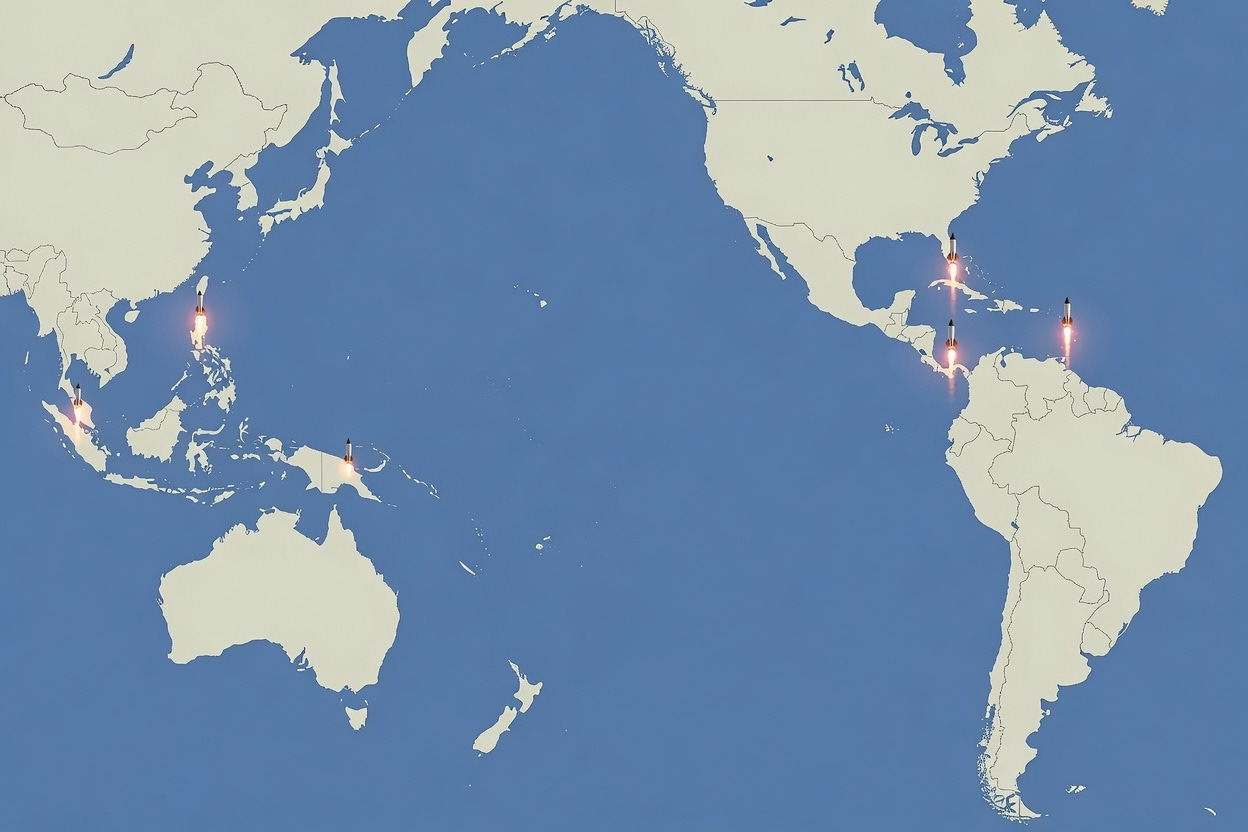
More than four and a half centuries ago, the Galleon Trade ushered in a Spain-led global economy and financed the growth of Spanish colonies on both sides of the Pacific.
On one end of that route, Manila became the hub — the gathering point where spices from Indonesia and silk from China were consolidated before making the crossing to Spanish America, and from there on to Europe. On the other end, Acapulco played the mirror role, the hub where silver from the mines of Bolivia and Mexico was gathered and shipped west to Asia. Neither city set the terms of the trade that ran through it. Both simply happened to sit where the geography demanded a port.
More than four and a half centuries hence, the pattern is repeating, and it’s worth watching closely because the terms are still being written.
The Philippines has announced a spaceport in Northern Luzon, with an explicit vision of becoming the hub for space launches in the Asia-Pacific region. But the Philippines isn’t alone in reaching for that role. Indonesia is pushing Biak Island as a launch site. Malaysia, in partnership with China, has its own plans for a launch facility in the Pahang region. Three countries, one ambition, on Manila’s side of the old route.
On the other side of the Pacific, the race is further along. Two launch facilities are already operational — the Guiana Space Center in French Guiana, and the Alcântara Space Center in Brazil — and a third is in development, a commercial spaceport near Oviedo in the Dominican Republic’s Pedernales province, backed by the Florida-based firm Launch on Demand. Three sites, in various stages of maturity, on Acapulco’s side.
Just as Manila and Acapulco became the two economic hubs of a Spain-led global economy four and a half centuries ago, these six facilities — operational and proposed — are now vying to become the new economic hubs of the emerging space economy.
The question worth asking isn’t which of them will get built. It’s which of them, this time, ends up owning a piece of the trade that runs through it — rather than just supplying the harbor.
Vicente Diño is the writer and publisher behind Galleon Space — a newsletter covering the space economy in Southeast Asia and Latin America | @GalleonSpace